Beyond Benjamin Bates
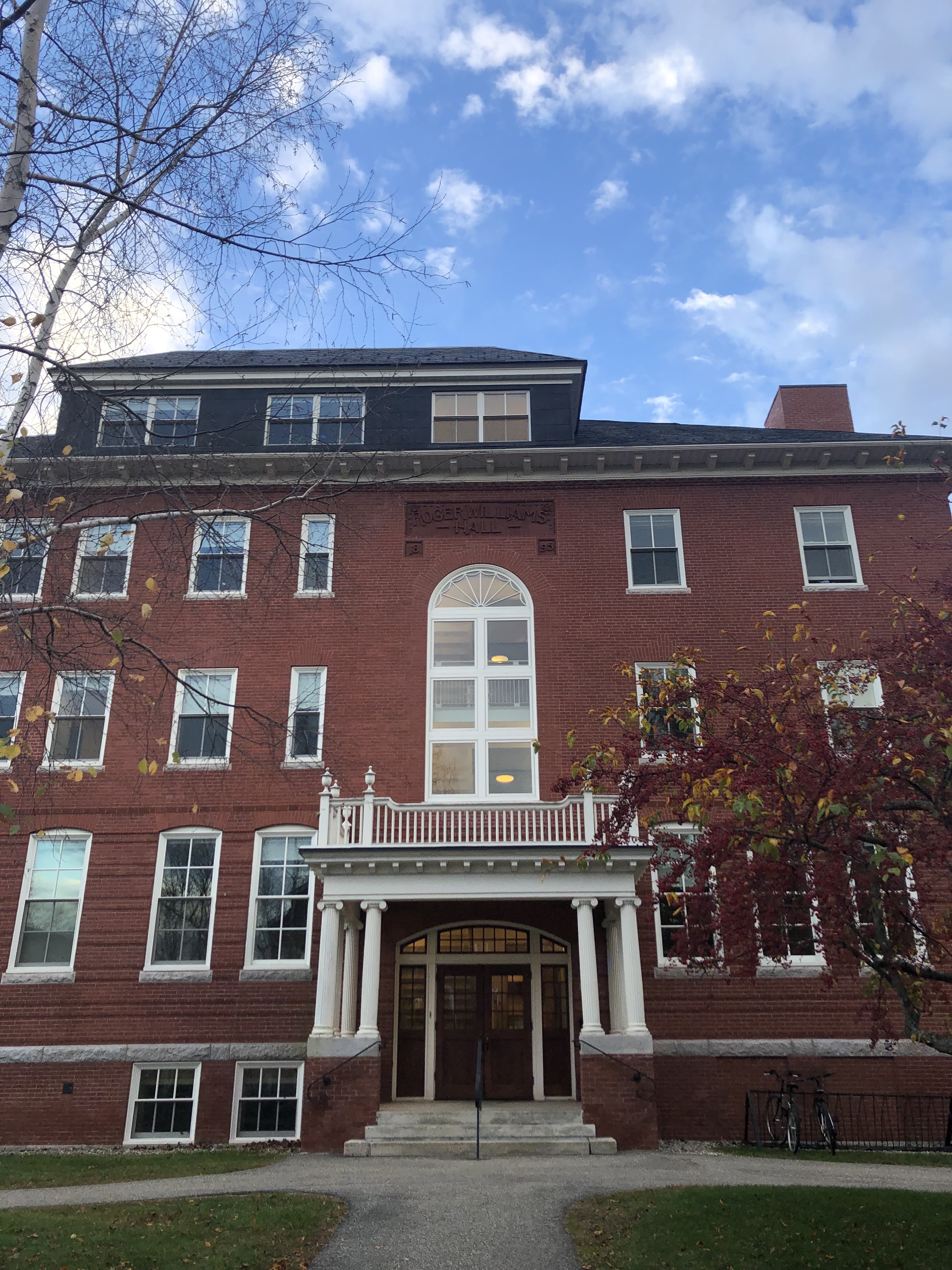
This is a project I worked on in a course I just finished, called Archives, Data, and Analysis. It explores the early donations to the Maine State Seminary, the precursor institution to Bates College.
Introduction
When thinking about the financial history of Bates College, there is one name that immediately comes to mind: Benjamin Bates. In recent years, Benjamin Bates’s life and legacy has become a point of interest as we, like other colleges, grapple with our early history. Benjamin Bates was a cotton magnate, whose business depended on purchasing cheap row cotton, produced by enslaved workers in the American South, and transforming it into fabric through the work of underpaid mill operatives in Maine.
But, Benjamin Bates was hardly the only person who provided financial support in the early days of the College. This project aims to think more about the many smaller donations recorded in the ledger of the Maine State Seminary. In particular, we will think about where the money that supported the newly-formed Seminary came from. Were there certain geographic areas that contributed more? Is there meaningful difference between donations from Maine, and those from outside of Maine? What about differences between counties?
Context
In 1855, Oren B. Cheney, a dedicated abolitionist and Freewill Baptist minister, founded the Maine State Seminary. When the Maine state government granted Cheney a charter for his educational institution, they put in place a stipulation that he could only access state-awarded funds if the Seminary was able to raise $15,000 in private donations (“March 16, 1855: Maine State Seminary Wins its Charter”). Cheney’s dire search for money and land for his Seminary led him to Lewiston, a city home to a bustling manufacturing industry, including the textile mills of Benjamin Bates.
Benjamin Bates was a cotton magnate. In the 1850s, he established the Bates Manufacturing Company, building a massive cotton mill utilizing the water power generated by the waterfall in the Androscoggin River that is located in what we now call the cities of Lewiston and Auburn (Soler). Before colonization, this land, the river, and the falls were home to the peoples of the Wabanaki Confederacy, upon whose unceded land Bates College is built.
The Bates Manufacturing Company started to become prosperous in the antebellum era, but grew even more during the Civil War. Before the war began, Benjamin Bates bought massive quantities of cotton, produced by the unpaid labor of enslaved workers in the southern United States (Soler). As cotton prices soared during the Civil War, the Bates Mill made massive profit from the stockpile of cotton bought at pre-war prices (Leamon). Benjamin Bates accrued massive wealth during the 1860s, using raw materials created by enslaved workers and exploiting the labor of underpaid mill workers.
Benjamin Bates’ wealth was inseparably tied to the practice of slavery, but Oren Cheney was desperate for funds. Thus began the connection between Cheney’s abolitionist institution and the cotton magnate Benjamin Bates. Bates gave approximately $200,000 to the Maine State Seminary over the course of his lifetime (Soler), and, in 1864, the college was renamed to Bates College in his honor (“Oren B. Cheney”).
However, Benjamin Bates was hardly the only donor to the newly-founded Maine State Seminary. This project explores the institution’s 1855-1857 donation ledgers, which record over $25,000 in total donations from individuals other than Benjamin Bates.
Data Preparation
The data for this project come from Lab #6 of the course Archives, Data, and Analysis (DCS204). The data consist of transcriptions from the treasurer’s ledger of the Maine State Seminary from 1855 to 1857.
Because these data have been transcribed from 19th-century cursive handwriting, some transcription errors can be expected. This is particularly true of the “Location” column, which records the city or town the donation came from. For the purposes of this project, any misspellings have not been corrected or changed, but misspellings have been included in the list of towns in each county in order to correctly sort all donations into their proper county. For example, the town of Harrison in Cumberland county is frequently spelling “Harison” in the data, so “Harison” is included in the list of towns in Cumberland county.
Prior to county identification, the data have been sorted into Maine and Non-Maine through the addition of an indicator column called is_not_maine. This column will have a 1 if the donation is from outside of Maine; this is determined by whether the sub-strings “nh”, “n.h”, or “ma” are present in each location value. Of course, there are some town names in Maine that contain these sub-strings as well, such as Bowdoinham and Madison. This has been corrected by identifying those towns and overwriting the is_not_maine value for each row containing one of these towns to be 0.
Some additional dataframes were produced in the process of this project. First, using the is_not_maine variable, the original mss_donors dataframe was separated into mss_donors_maine and mss_donors_notmaine. Each of these dataframes were used to make a table showing the distribution of donation amounts (more on this in the Analysis section). The Maine dataframe was also used to create a table summarizing the total sum and count of donations for each county.
The county summary table was used in conjunction with county spatial data from the Maine GeoLibrary data catalog to create a choropleth map of total donations by county. The spatial data was so high-resolution that this map was taking far too long to load, so the function rmapshaper::ms_simplify was used to simplify the shapes. The county data were used to determine the fill colors of each county.
Analysis
When thinking about the founding of the Maine State Seminary, it is easy to assume that financial support for the institution came entirely from wealthy residents of New England’s largest cities – the Benjamin Bateses of the region. However, analysis of the 1855-1857 donation ledgers reveals that this is not necessarily the truth.
Chi-Squared Tests: Distribution of Donations
The first question to ask of this data is whether there is a statistically significant difference in the distribution of amounts between donations from Maine and donations from outside of Maine. To answer this question, we can perform a chi-squared test of independence.
To prepare the data for a chi-squared test, we must create a table of counts, separating the donations into categories based on amounts and whether or not they came from Maine:
1##            <5 5-10 10-20 20+
2## Maine     230  100    62 136
3## Not Maine  12    4     1   2
1##
2## 	Pearson's Chi-squared test
3##
4## data:  dist_table
5## X-squared = 3.9901, df = 3, p-value = 0.2625
The Chi-square test resulted in a p-value of 0.2625, indicating that there is a 26% likelihood that the differences in these two distributions are due to randomness. Thus, there is not likely a statistically significant difference in distribution between donations from Maine and donations from outside of Maine.
But what about within Maine? The Chi-squared test can be repeated, this time grouping the donations by county and removing all rows containing zeros.
 1##              <5 5-10 10-20 20+
 2## Androscoggin 64    4     3   6
 3## Cumberland   41   21     5  16
 4## Franklin     16    8     5  21
 5## Kennebec     11   14    13  14
 6## Lincoln       4    2     3   7
 7## Penobscot     2    4     8  12
 8## Sagadahoc    21   15     7   8
 9## Waldo        16    3     4   5
10## York         26   13     5   9
1##
2## 	Pearson's Chi-squared test
3##
4## data:  dist_table_revised
5## X-squared = 110.79, df = 24, p-value = 4.105e-13
This Chi-squared test produced a very small p-value, indicating that there is very little chance that the differences in donation distribution between counties is due to random variation.
Map: What counties donate the most?
After establishing that there are meaningful differences in donation amounts between counties, the obvious next step is to investigate these differences.
Using the data frame county_data_merged, which combines spatial data for the boundaries of counties with total donation amounts by county, we can produce a map in which each county is shaded according to its total donation amount to the Maine State Seminary.
It is important to note that the counties of Maine were still in flux during the 1850s and 1860s. Three counties – Androscoggin, Knox, and Sagadahoc – did not yet exist at the time of the 1850 Federal Census. I have sorted the towns and cities of Maine into their modern county associations for ease of comparison.
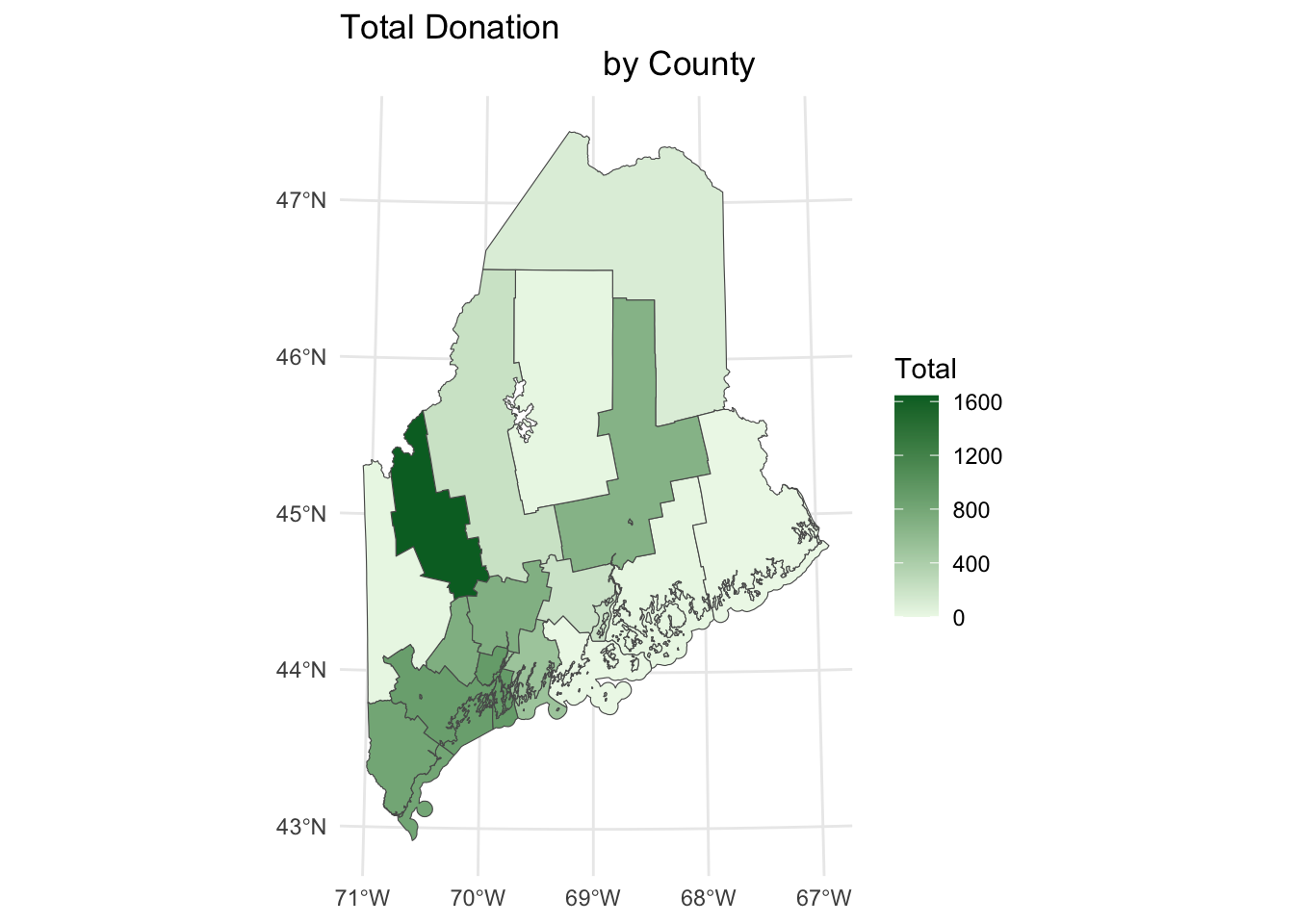
This map produces a surprising result: the county with the highest total donation is not Androscoggin, where the Maine State Seminary was located, nor is it Cumberland, which is home to Portland. It is instead Franklin county, which had a population of roughly 20,000 in the 1850 census, making it the third smallest county in Maine at the time (US Census Bureau). Farmington was Franklin county’s largest city at the time, with a population of just under 3,000; in comparison, Lewiston had about 3,500 residents, and Portland had a population of just over 20,000.
Interestingly, Franklin county does not have the highest number of individual donations. Cumberland and Androscoggin counties had far more donations, but still had lower totals than Franklin. This indicates that Franklin county must have contributed relatively fewer, but larger donations. In fact, six of the 22 donations of $100 or higher came from Franklin county. In contrast, Androscoggin had the highest share of donations of $1 or less.
Where exactly was all this Franklin county money coming from? The data indicate that the source of much of Franklin county’s donations were a few wealthy people donating in large increments. One of these individuals Thomas Parker, a resident of Farmington, who gave a total of $500. According to the 1850 Census, Parker was a mason. Parker became the namesake of Parker Hall, the college’s first dormitory (“History of Bates Campus Buildings”). William Toothaker of Phillips, who is listed in the 1850 Census as a farmer with $4700 worth of real estate, contributed over $300 in 1857, making him one of the largest individual donors in the treasurer’s ledger.
It is perplexing why certain donors are commemorated, while others have completely disappeared from the collective Bates memory. Seth Hathorn and Thomas Parker became the namesakes of some of the most iconic buildings on the Bates campus, while our farmer William Toothaker has been completely forgotten. We remember the generosity of Lewiston during the founding of the college, but have completely overlooked the role of Franklin county in our founding. As we work to tell a more complete story of our history, we should include these overlooked aspects.
References
“History of Bates Campus Buildings.” Edmund S. Muskie Archives and Special Collections Library. https://www.bates.edu/archives/history-of-bates-campus-buildings/
Leamon, James S. Historic Lewiston: A Textile City in Transition. Lewiston Historical Commission, 1976. https://www.lewistonmaine.gov/DocumentCenter/View/1191/Historic-Lew-A-Textile-City-in-Transition-1976?bidId=
“March 16, 1855: Maine State Seminary Wins its Charter.” Bates College Communications. 2005. https://www.bates.edu/150-years/months/march/maine-wins/
“Oren B. Cheney”. Bates College Communications. 2005. https://www.bates.edu/150-years/bates-greats/oren-b-cheney/
Soler, Emma. “Chapter 1: Founded by Abolitionists.” Founded by Abolitionists, Funded by Slavery: Past and Present Manifestations of Bates College’s Founding Paradox. Honors Thesis, 2020.
US Census Bureau. “Statistics of Maine.” Census of 1850. https://www2.census.gov/library/publications/decennial/1850/1850a/1850a-16.pdf