Hunting and Gathering
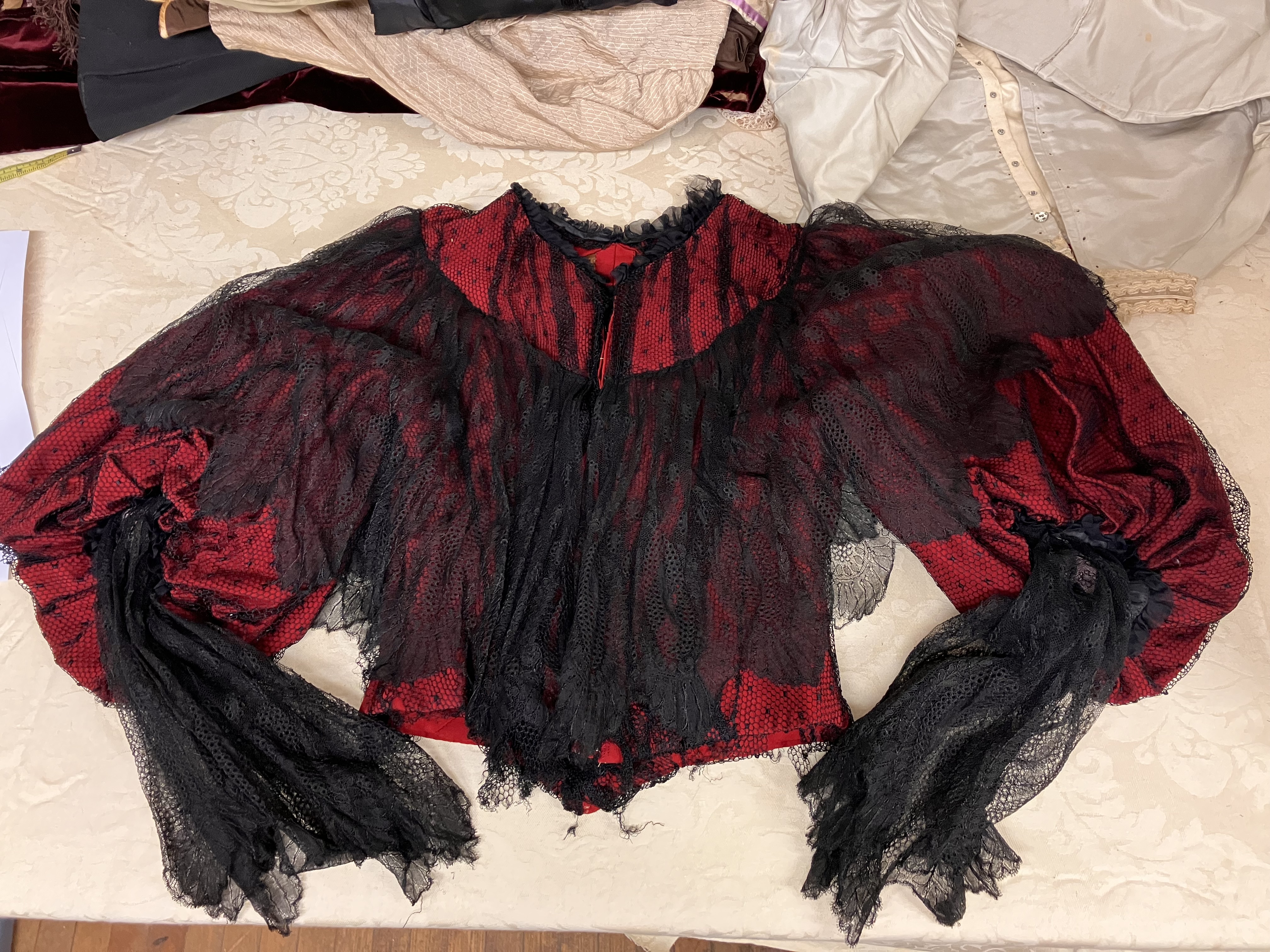
I’ve been an explorer the past few weeks.
As I begin working with my thesis collection, I am in a rather puzzling position: nobody actually knows what is in the collection. That’s the whole point of my thesis; the Bates College theater department owns boxes and boxes of historic dress, but there are no records or institutional memory of what is in those boxes. My job is to make the collection useful, both in physical and digital forms - but how do I even start?
Well, I’ve started at the beginning (a very good place to start): hunting through boxes to figure out what is in them.
The outcome? There is way too much stuff - 175 pieces of clothing, to be precise. Not all of it is going to be kept; as I progressed through the mountain of boxes, I pulled out pieces that were in extreme states of disrepair, or that had been so severely altered for the stage as to no longer be considered historical, and put them in a “deaccession” pile. Of course, nothing has technically been accessioned, so this isn’t a formal deaccessioning process, but calling it a garbage pile feels mean to the clothes.
Now that I’ve hunted, I need to gather a subset that will be my official thesis collection. Where do I even start? The objects cover about 75 years. It’s mostly women’s dress, but there are a handful of menswear pieces and children’s clothes thrown in. There’s outerwear, daywear, eveningwear, underwear… how do I narrow down?
Let’s look at the data.
I’ve put together a dataframe of just the most basic information about each piece: box of origin, object number within the box, category of object (bodice, skirt, etc.), condition (E = excellent, G = good, F = fair, P = poor), and an approximate date. Here’s the number of objects in each category:
Somehow, I’ve ended up with more skirts than anything else, which is a total surprise considering how often skirts are recycled into other garments. Let’s peek at the conditions of these skirts:
If I accession all of the Good and Excellent quality skirts, that will be 25 objects, covering a date range from 1855 to 2000 (which is actually a reproduction garment). This date range is huge - but what do the data look like?
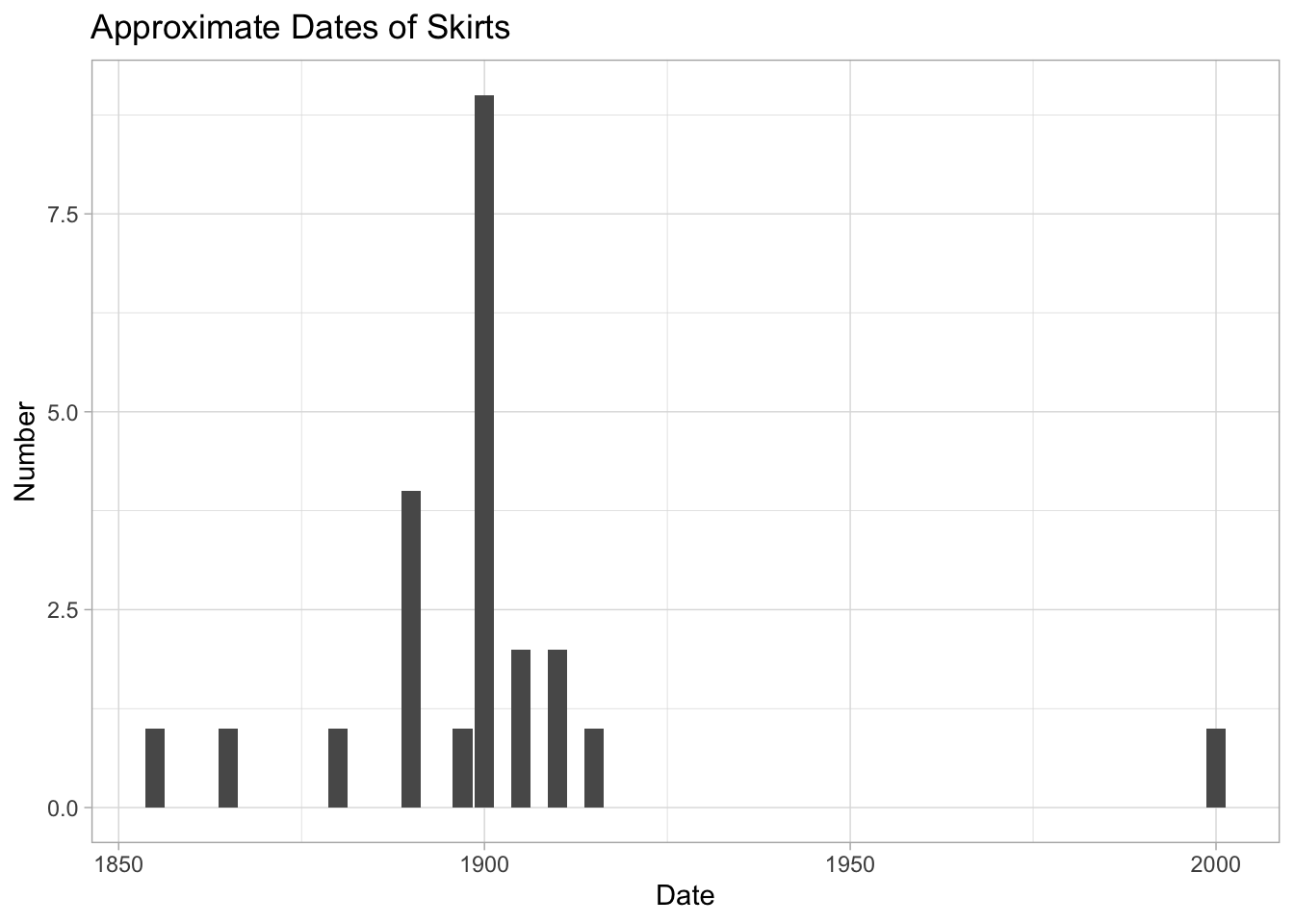
Well, if I drop the reproduction garment, then the remaining Good/Excellent skirts all fall between 1855 and 1920. This is much more managable. Let’s look at the same visualization for bodices:
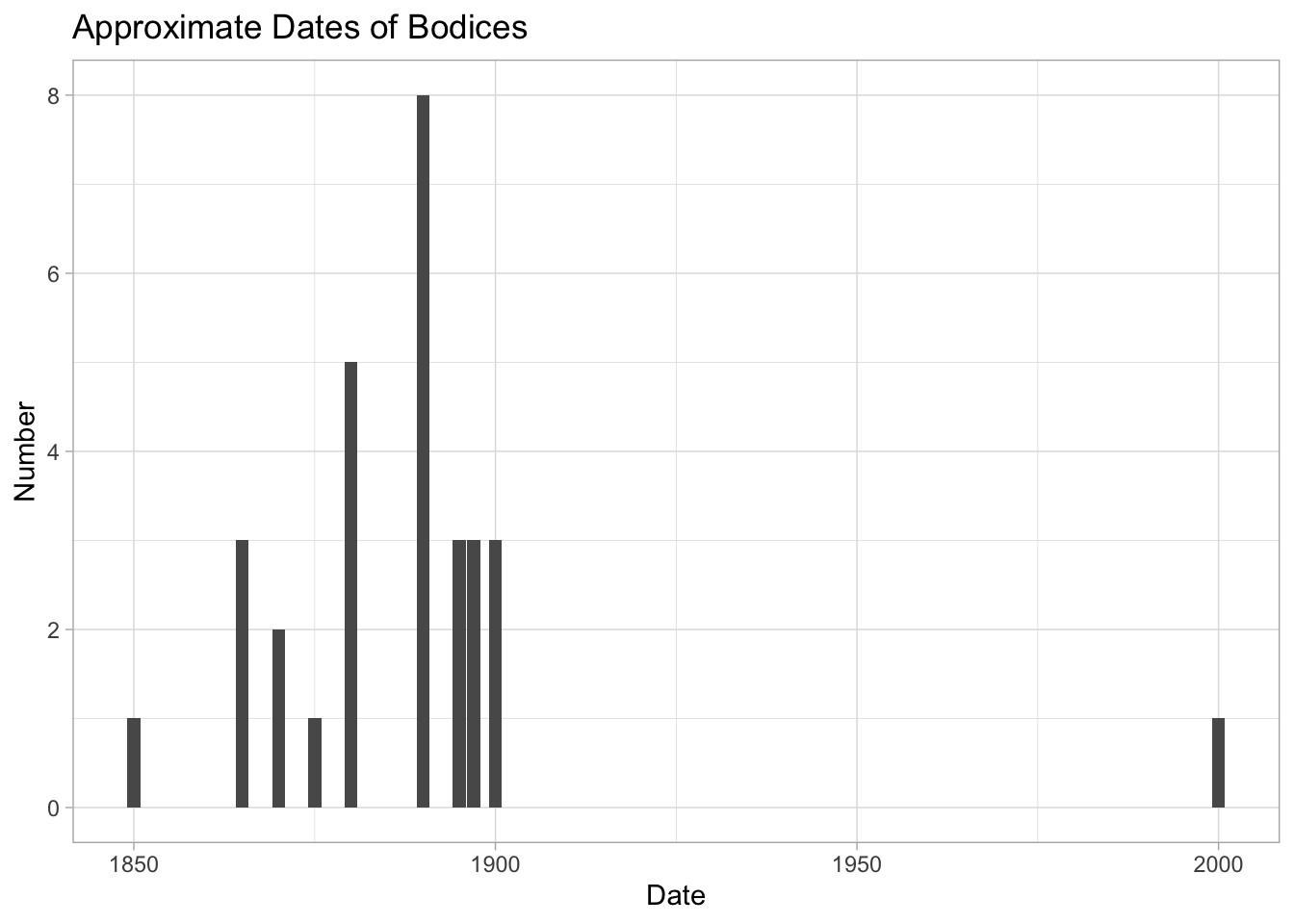
This distribution looks very similar, although the highest frequency date is closer to 1890 for bodices and around 1900 for skirts. However, skirts can be very difficult to date, especially when they were worn by more middle-class folks who didn’t necessarily keep up with every trend in skirt shape.
So how about just keeping the best condition garments?
In total, there are 119 objects in Good or Excellent condition. This is still way too many for me to digitize and catalog! Plus, there might be more unique or interesting garments that are not in good condition, but would be valuable additions to the collection.
Let’s look at things differently.
This is a heatmap of the data. A heatmap is a form of 3-dimensional visualization: the y-axis represents the dates of objects, the x-axis separates the objects into their categories, and the color of each square in the grid shows the relative number of objects that fit into that category and date range. For the purposes of seeing all of the objects, I have not filtered by condition.
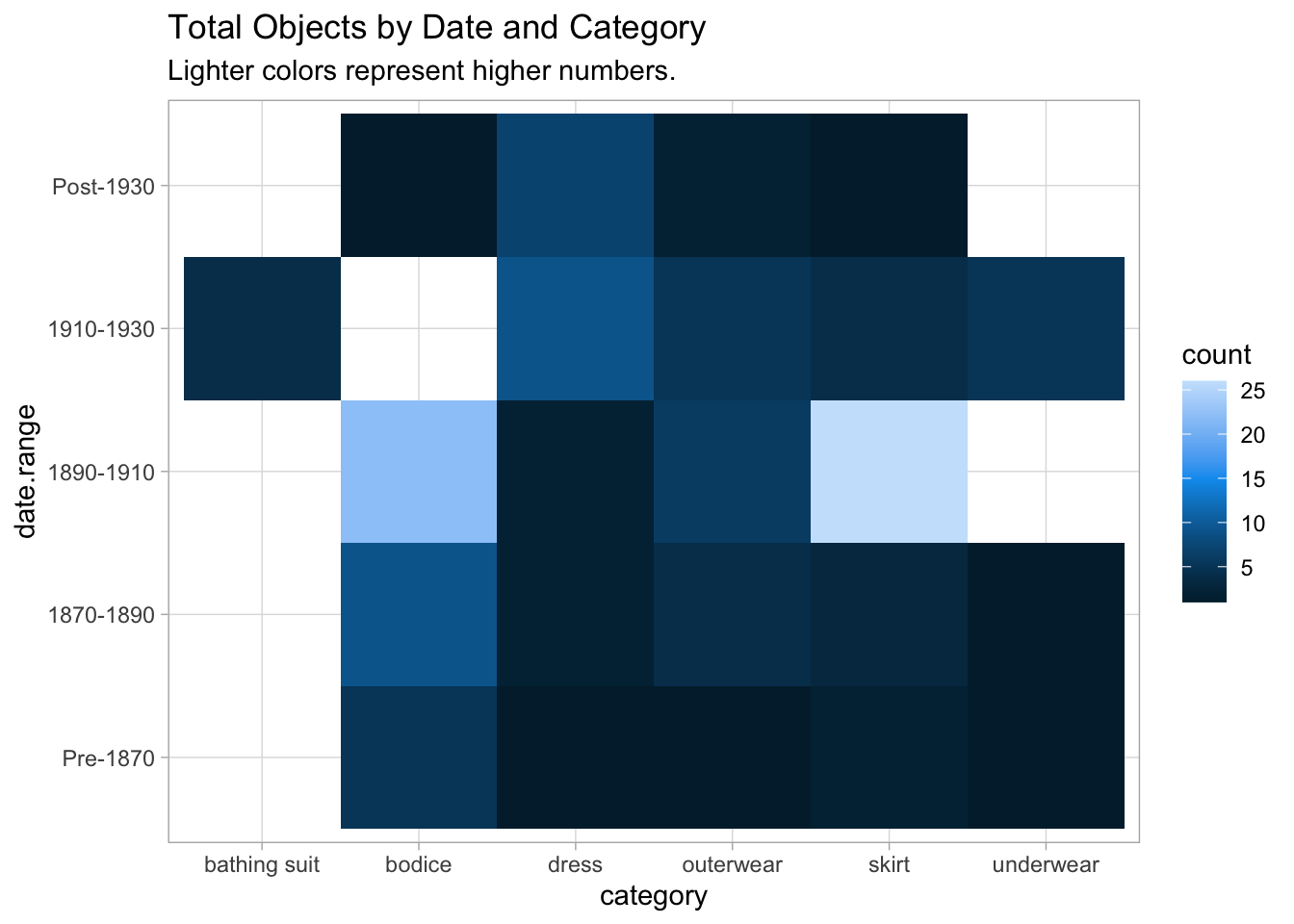
Looking across all categories, the range from 1890 to 1910 looks to have the most objects. If I wanted to zoom out a bit, 1870-1930 has solid representation in every category.
Of course, there are other variables to consider while making these decisions. I’ve found myself drawn to outwear during the process of going through boxes, and am tempted to center outerwear in the collection. There are some coats and capes in this collection that are totally unlike anything I’ve seen in other museums, which is another argument to prioritize them. Our selection of bodices is pretty standard for small New England collections (basically a lot of black wool), but there are some really intriguing pieces that would be nice to include.
There’s also a pretty self-evident sub-collection in here. When I was going through boxes, I found a big box full of smaller boxes, each of which housed just one or two garments. These boxes are fascinating because they are clearly the garments of a single family; there are notes written on or in most of the boxes, which are all written in the same handwriting and mention the same people multiple times. Basically, these boxes have clear provenance, which cannot be said for the majority of the objects in this collection. In total, there are 23 objects from these boxes, but not all of them are ideal for the purposes of my work – there are several pieces of children’s clothing, and a floral headpiece from a wedding, which don’t really draw my interest. But, all of the pieces in these boxes are in great condition, and the potential to have documented provenance is very appealing.
This week, my advisor and I will be working on this issue of object selection together. We also have a few more objects stored elsewhere to add to the mix. We’ll see what decisions we come to!